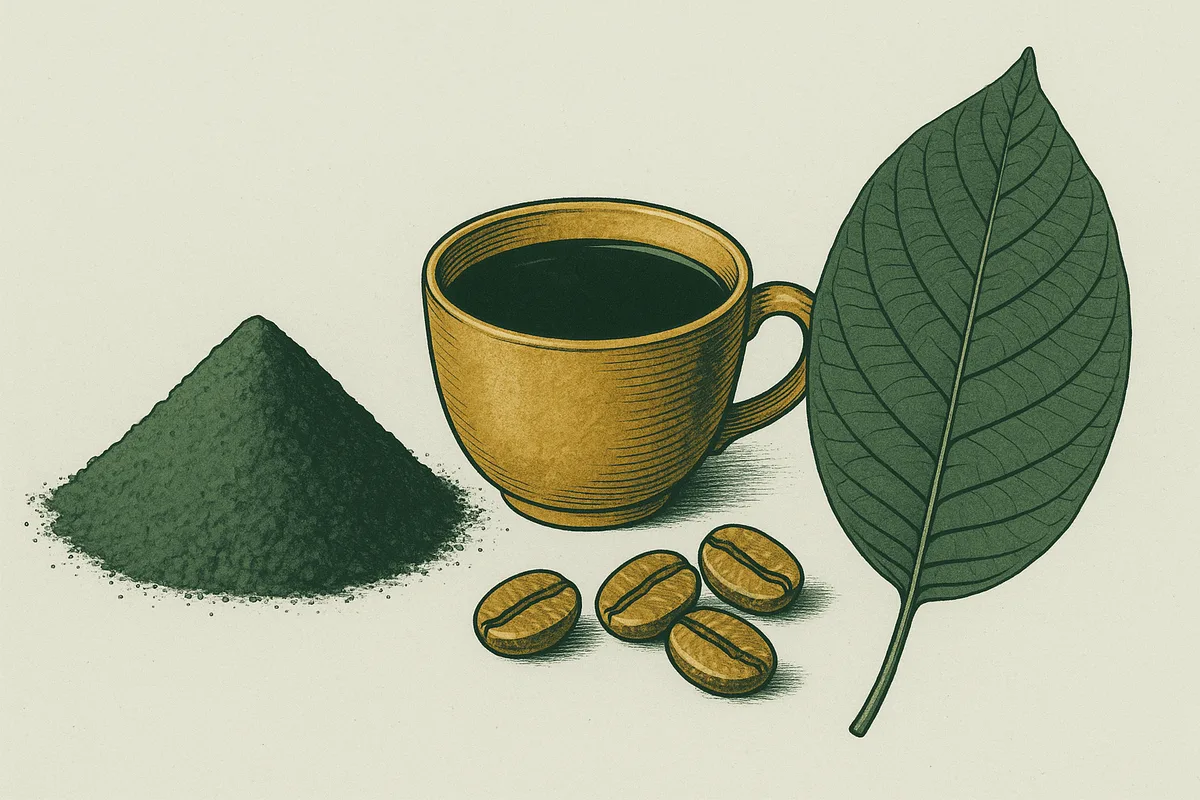
Kratom and coffee get compared constantly, and there is a real reason for it beyond both being morning pick-me-ups: they are botanical cousins. Coffee comes from the Coffea plant and kratom from Mitragyna speciosa, and both trees sit in the same family — Rubiaceae, the coffee family. That shared branch on the family tree is where the resemblance mostly ends. The two plants produce completely different active compounds that act on the body through different mechanisms, which is why "kratom is basically strong coffee" is one of the most persistent misconceptions in this space.
Here is the honest side-by-side: where the two genuinely overlap, where they diverge sharply, and why swapping one for the other is not the like-for-like trade it sounds like.
Safety & legal note. Kratom is not approved by the FDA for any use, and nothing here is medical advice or a recommendation to take any amount. Kratom can be habit-forming, unlike coffee. Kratom is banned in some US states — check your local law.
The botany: cousins, not twins
The family resemblance is real and verifiable. Both plants belong to Rubiaceae, the same botanical family, so calling kratom "coffee's cousin" is accurate rather than marketing spin.
But shared family does not mean shared chemistry. Coffee's active ingredient is caffeine. Kratom's is mitragynine, plus a smaller amount of the more potent 7-hydroxymitragynine. These are structurally and functionally different molecules. Being in the same plant family tells you the trees are related; it tells you nothing about how the compounds inside behave once they are in your system.
The mechanism: this is where they split
This is the part that gets glossed over, and it is the most important difference.
Caffeine works by blocking adenosine. Adenosine is a molecule that builds up through the day and makes you feel drowsy. Caffeine occupies the receptors adenosine would otherwise dock into, so the drowsiness signal does not land. That is the whole trick — it is a stimulant that masks fatigue.
Mitragynine acts at the body's opioid receptors. That is an entirely different pathway from caffeine's. Research characterizes the interaction as pharmacologically distinct from classic opioids in how the receptors signal downstream, but the receptor system involved is not the one caffeine touches at all.
So even when kratom and coffee are described in similar terms — "it gives me energy" — they are getting there by different routes. That difference in mechanism is also why they differ so much on tolerance and dependence further down.
The effects people describe
Coffee is straightforward: it is a stimulant across the board. More coffee is more stimulation, until you hit jitters and an racing heart. The dose-response line runs one direction.
Kratom is reported to be dose-dependent in a way coffee is not. Community sources commonly describe lower doses as stimulating and coffee-like — the comparison people reach for when they first try it — while higher doses are described in the opposite terms, more sedating than energizing. That is a self-reported pattern, not an established clinical dose curve, and individual response varies. But it is the single biggest reason the "kratom = coffee" framing breaks down: coffee does not flip its character as the dose climbs.
Vein color layers on top of that. Community sources associate whites and greens with energy and reds with relaxation — our best kratom for energy guide covers which strains people actually name. Coffee has no equivalent axis; a cup is a cup.
Tolerance and dependence
Both build tolerance, but not to the same degree.
Coffee's dependence is mild. Regular drinkers build some caffeine tolerance and can get headaches or grogginess if they stop abruptly, but caffeine withdrawal is generally short-lived and modest.
Kratom's dependence potential is more significant. Because mitragynine acts at opioid receptors, regular heavy use can lead to tolerance and physical dependence that is more substantial than caffeine's, and stopping after sustained heavy use is reported to be harder. This is the difference the safety note at the top flags: kratom can be habit-forming in a way a coffee habit is not. Anyone weighing one against the other should weight this heavily rather than treating both as harmless daily rituals.
Side by side
| Coffee | Kratom | |
|---|---|---|
| Plant | Coffea | Mitragyna speciosa |
| Family | Rubiaceae | Rubiaceae (same family) |
| Active compound | Caffeine | Mitragynine (+ 7-hydroxymitragynine) |
| Mechanism | Blocks adenosine (stimulant) | Acts at opioid receptors |
| Dose response | More = more stimulation | Low reported stimulating; higher reported sedating |
| Tolerance | Mild | More significant |
| Dependence risk | Mild, short withdrawal | Higher; can be habit-forming |
| Regulation | Widely available food/beverage | Not FDA-approved; banned in some states |
Can you replace coffee with kratom?
The honest answer is no, not as a straight swap.
They are not interchangeable because they do not work the same way. Coffee is a clean stimulant with mild dependence. Kratom acts on a different receptor system, flips character with dose, and carries a meaningfully higher dependence risk. Some people do reach for a low dose of a white or green strain for a coffee-like lift, and report it feels comparable — but "feels comparable at a low dose" is not the same as "is the same thing." You would be trading a mild-dependence stimulant for a compound with a different mechanism and a steeper risk profile.
If the goal is simply energy, coffee is the lower-risk option and there is no reason to overthink it. If you are exploring kratom for other reasons and want to understand dosing before anything else, start with the kratom dosage guide — a gram is not a fixed unit, and the low-dose-versus-high-dose split above is exactly why dose matters more here than it does with a cup of coffee.
Where to buy
If you are going to try kratom, the thing that matters most is buying tested product from a vendor that publishes a current third-party COA. All three vendors we track do.
Our code getketum takes 15% off at Kraken Kratom, our top-ranked vendor — AKA-GMP qualified, third-party tested, and the strongest trust signal available in this market. Also worth comparing: Kats Botanicals for the best per-gram value at mid-size packs, and Kona Kratom for the cheapest bulk pricing with a money-back guarantee.
For the full ranked comparison, see best kratom vendors.
The bottom line
- Cousins, not twins. Kratom and coffee share a botanical family (Rubiaceae) but produce different active compounds.
- Different mechanisms. Caffeine blocks adenosine; mitragynine acts at opioid receptors — not the same pathway.
- Kratom is dose-dependent in a way coffee is not — reported stimulating low, sedating high — while coffee runs one direction.
- Dependence differs. Coffee is mild; kratom can be habit-forming and carries a higher tolerance and dependence risk.
- Not a like-for-like swap. For plain energy, coffee is the lower-risk choice. If you try kratom, buy tested product and read the dosage guide first.