The short answer is: not exactly, and the disagreement is real. Kratom's main alkaloids act on the same receptor that morphine and heroin act on — so pharmacologically it has opioid-like activity. But kratom is not a classical opioid: it is a plant compound, chemically unrelated to anything from the opium poppy, and the way it engages that receptor is measurably different. Whether "opioid" is the right word depends entirely on whether you are asking about mechanism or about chemistry, and the two answers point in opposite directions.
That split is why you will see the FDA and DEA describe kratom in opioid-adjacent terms while chemists object to the label. Both are being accurate about different things. This page walks through what the research actually shows, so you can hold the real answer instead of either headline.
Safety & legal note. Kratom is not approved by the FDA for any use, and nothing here is medical advice. Kratom can be habit-forming; vendors' own labels advise against long-term use. Kratom is banned in some US states — check your local law.
What kratom actually is, chemically
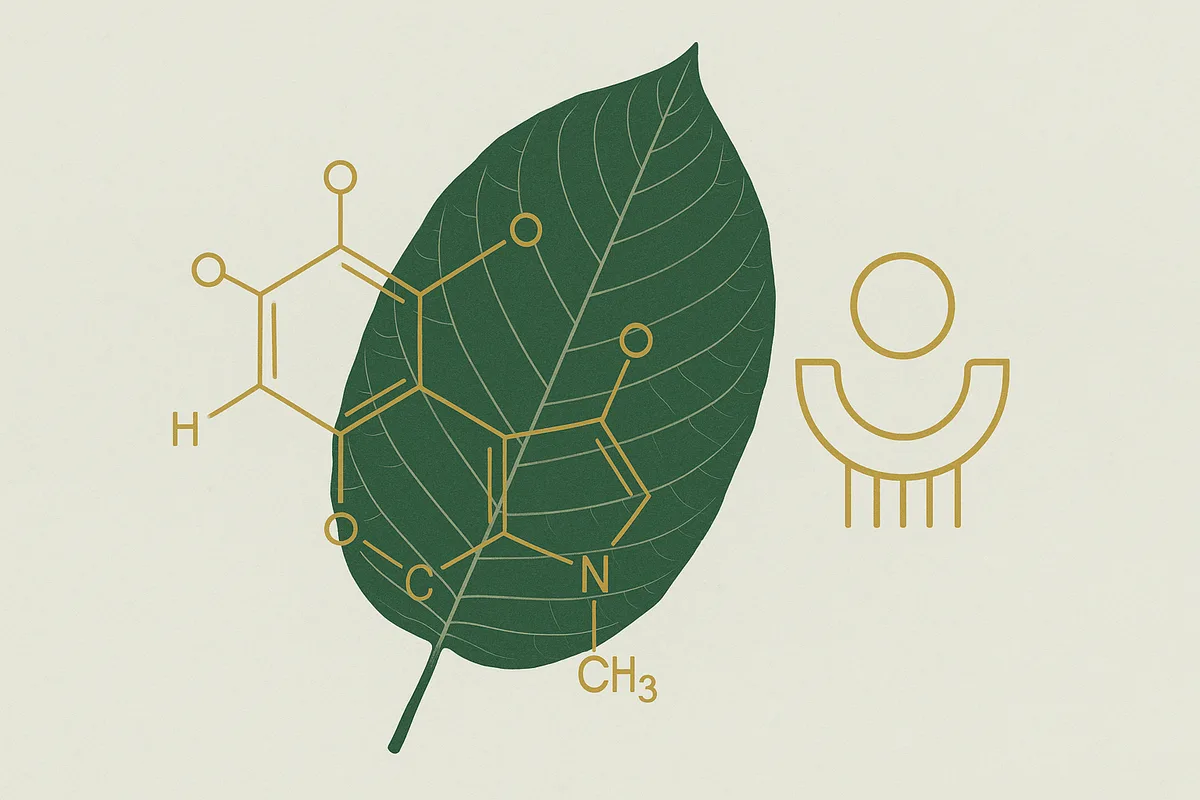
Kratom is the dried leaf of Mitragyna speciosa, a tree in the coffee family native to Southeast Asia — the full plant background is in what is kratom. Its effects are driven mainly by two indole alkaloids: mitragynine, the most abundant compound in the leaf, and 7-hydroxymitragynine, present in much smaller amounts but more potent at the receptors involved.
Here is the chemistry point that matters for the "opioid" question. Classical opioids — morphine, codeine, heroin — are derived from or built on the opium poppy, and share a common morphinan skeleton. Mitragynine is a completely different class of molecule: an indole alkaloid, structurally unrelated to morphine, produced by a different plant on a different continent. On chemistry alone, calling kratom an "opiate" is simply wrong. An opiate comes from the poppy. Kratom does not.
So if the word is going to apply at all, it has to be for a different reason.
Why it engages opioid receptors anyway
That reason is the receptor. Structurally unrelated molecules can still fit the same lock, and this is what kratom does. Research characterizes both mitragynine and 7-hydroxymitragynine as agonists at the mu-opioid receptor — the same receptor responsible for the analgesia, euphoria, and respiratory depression of conventional opioids (Nature, 2026).
This is the finding that drives the opioid-adjacent framing. When agencies note that kratom "activates opioid receptors" or carries "opioid-like effects," they are describing this receptor activity, and they are correct to. It is why kratom is used and studied the way it is, and why dependence is a genuine concern rather than a theoretical one.
But the research adds two qualifiers that the blunt "it's an opioid" version leaves out.
It's a partial agonist, not a full one. Studies describe mitragynine as a partial agonist at the mu-opioid receptor — it does not fully activate the receptor the way morphine, a full agonist, does (Nature, 2026). Some assays go further, finding mitragynine itself behaves closer to an antagonist while its metabolite 7-hydroxymitragynine does the partial-agonist work, at roughly fivefold greater receptor affinity (ScienceDirect). Either way, "engages the receptor" and "engages it the way a classical opioid does" are not the same claim.
It signals differently once bound. Multiple studies describe kratom's alkaloids as G-protein biased — they preferentially trigger G-protein signaling with little to no measurable recruitment of beta-arrestin, the downstream pathway most associated with some of the severe opioid liabilities (ScienceDirect review). This "biased agonism" is exactly why kratom has drawn research interest as pharmacologically distinct, and why researchers have hypothesized a different effect-and-risk profile from conventional opioids. It is a hypothesis under study, not a settled safety claim — but it is a real, documented difference in how the molecule works.
So the honest pharmacological summary is: kratom is an atypical, partial, G-protein-biased mu-opioid agonist of botanical origin. That is a mouthful, which is precisely the problem — every word of it gets flattened when the question is reduced to a yes/no.
Why "opioid" is a contested label
Put the two halves together and the disagreement makes sense:
- By chemistry, kratom is not an opioid — no poppy, no morphinan skeleton, a different molecular class entirely. "Opiate" is flatly inaccurate.
- By pharmacology, it has opioid activity — it acts on the mu-opioid receptor, which is why terms like "opioid-like" are defensible and why the effects and the dependence risk are real.
This is why credible sources land in different places without necessarily contradicting the facts. The FDA has publicly characterized kratom's compounds as opioids on the basis of receptor activity and computational modeling — a mechanism-first framing. Chemists and many researchers push back that the label overstates the similarity and ignores the structural and signaling differences. Both can be citing accurate information; they are answering different questions under the same word.
The practical takeaway is to distrust any source that gives you a clean one-word answer in either direction. "Kratom is just an opioid" erases the chemistry and the biased-signaling data. "Kratom is nothing like an opioid" erases the receptor activity and the dependence record. The accurate position lives in the qualifiers.
The part that isn't contested: dependence
Whatever you call it, one consequence is well documented and worth stating plainly. Because kratom does engage the mu-opioid receptor, it carries genuine potential for tolerance, dependence, and withdrawal with heavy or prolonged use. This is not a fringe claim — it shows up in case reports, in user experience, and in the vendors' own labeling.
Reputable sellers print this directly: kratom may be habit-forming and is not recommended for long-term use. Withdrawal descriptions in the literature resemble a milder opioid withdrawal — irritability, muscle aches, runny nose, trouble sleeping — rather than something categorically different. Concentrated extracts, especially those elevated in 7-hydroxymitragynine, raise this risk further than plain leaf, which is one more reason we treat extracts as a separate risk category. The broader safety picture, including contamination and what testing can and cannot tell you, is covered in is kratom safe.
None of this depends on winning the terminology argument. The receptor activity is real; the dependence potential follows from it; the label is a separate debate.
Where to buy
If you do choose to buy kratom, the single most protective step is a vendor that publishes current, per-batch third-party testing — because the dependence question above is compounded, not caused, by contaminated or mislabeled product. Our full ranked comparison of the best kratom vendors weights lab testing heavily for that reason.
Our code getketum takes 15% off at Kraken Kratom, our #1-ranked vendor. Kraken was the first seller in the industry to earn American Kratom Association GMP qualification, publishes its third-party testing methods by name, and has held that annually audited credential since 2019 — the strongest quality signal available in this market.
Also worth a look are Kats Botanicals, which offers batch-level COA lookup so you can match the certificate to your own bag, and Kona Kratom, consistently the best value per gram while carrying the same AKA GMP credential.
The bottom line
- Chemically, kratom is not an opioid or an opiate. Its alkaloids are indole alkaloids from a plant unrelated to the opium poppy, with no shared morphine-type structure.
- Pharmacologically, it has opioid activity. Mitragynine and 7-hydroxymitragynine act as agonists at the mu-opioid receptor, which is why "opioid-like" is a defensible description.
- The activity is atypical. Research describes them as partial agonists that are G-protein biased — engaging the receptor differently from full classical opioids like morphine.
- That difference is why the FDA/DEA and chemists disagree. Mechanism-first framing calls it an opioid; chemistry-first framing says it isn't. Both cite accurate facts about different questions.
- The dependence risk is not contested. Tolerance, dependence, and withdrawal are documented with heavy use, and extracts raise the risk — vendors' own labels warn against long-term use.
- Kratom is not FDA-approved for any use, and nothing here is a claim that it is safe or a treatment for anything.