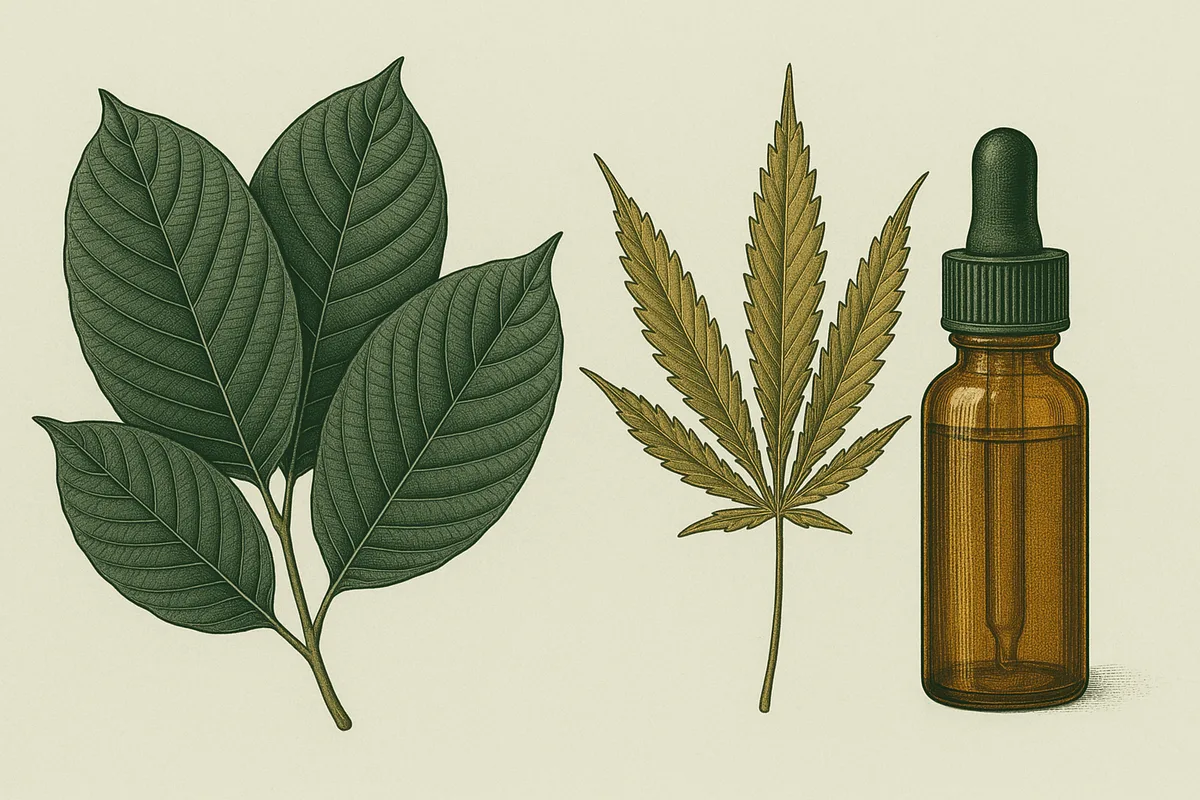
Kratom and CBD get compared because they share a shelf — the same smoke shops, the same wellness aisles, sometimes the same brands. But they are not two versions of the same thing. Kratom is the leaf of a Southeast Asian tree (Mitragyna speciosa) whose alkaloids act at the body's opioid receptors; CBD (cannabidiol) is a single compound extracted from hemp (Cannabis sativa) that works through a spread of other targets and does not act like an opioid. Different plant, different chemistry, different legal framework.
The short version: kratom is a whole-leaf botanical with stimulating-to-sedating reports and real dependence potential; CBD is an isolated, non-intoxicating cannabinoid whose main caveats are product quality, drug interactions, and — this year especially — federal hemp law.
Safety & legal note. Kratom is not approved by the FDA for any use, and nothing here is medical advice. Everything below reports how each substance is described and regulated, not clinical effects. Kratom can be habit-forming, is banned in some US states, and is not for anyone under 21 — check your local law.
Different plants, different products
Kratom is sold as the dried, ground leaf of Mitragyna speciosa, a tree in the coffee family native to Thailand, Malaysia, and Indonesia. What you buy is the plant material itself — powder, capsules, or (separately) concentrated extracts. We cover the plant's background in what is kratom.
CBD is different in kind. It is one molecule out of more than a hundred cannabinoids in the cannabis plant, extracted (almost always from hemp) and then put into oils, gummies, capsules, and topicals. Products are labeled by how much else comes along:
- Isolate — CBD only.
- Broad-spectrum — other hemp compounds, with THC removed.
- Full-spectrum — the whole extract, including trace THC.
That distinction matters more than it used to, for reasons covered in the legal section below.
Different chemistry
This is where the real gap lies.
Kratom's activity comes mainly from two alkaloids: mitragynine, the most abundant, and 7-hydroxymitragynine, present in small amounts but much more potent. Both act at opioid receptors. The research literature describes them as pharmacologically unusual compared with classic opioids, but it is the same receptor family — which explains both the effects users report and kratom's dependence potential. (Concentrated 7-OH products are a separate category; see kratom vs 7-OH.)
CBD does not act at opioid receptors and, despite the name, binds only weakly to the main cannabinoid receptors (CB1 and CB2). It is described as acting on several systems at once, including serotonin receptors and the body's broader endocannabinoid signaling. Unlike THC, it is non-intoxicating: it does not produce a "high."
What people say they use each for
Neither substance is approved to treat any condition as sold over the counter, so what follows is how users describe them — not established effects.
Kratom is described as dose-dependent in a way CBD is not. Users commonly report that lower amounts feel energizing and focusing, which is why white and green veins dominate searches like best kratom for energy, while higher amounts and red veins get described as relaxing and heavy. Strain choice and batch strength both shift the experience noticeably.
CBD is described far more subtly. The most common user language is "calm," "taking the edge off," or "unwinding," and plenty of people report feeling very little. There is no stimulating end to the range. People also tend to use it more casually and steadily, as a background wellness product rather than something with a noticeable onset.
So when someone asks "kratom or CBD," they are usually choosing between something noticeable and variable and something mild and steady.
Different legal status — and a big change on November 12
For US buyers this is now the most practical difference.
Kratom is not a federally controlled substance, but the FDA's position is that it cannot be lawfully marketed as a drug, dietary supplement, or food additive. It is banned in a handful of states and some cities and counties, while other states have passed Kratom Consumer Protection Acts that set age limits, labeling rules, and testing requirements. Regulators have moved separately against concentrated 7-OH products. Our state-by-state guide has the current picture.
CBD has been federally legal since the 2018 Farm Bill as long as it comes from hemp containing no more than 0.3% delta-9 THC. Like kratom, though, it is not FDA-approved as a supplement or food ingredient — the only FDA-approved CBD product is a prescription drug (Epidiolex), which is a separate thing from what is sold over the counter.
That federal picture is about to change. The November 2025 appropriations law redefines hemp starting November 12, 2026: the limit moves from delta-9 THC to total THC, and finished hemp products are capped at 0.4 mg of total THC per container. Isolate and properly made broad-spectrum CBD are designed to contain no THC, but many full-spectrum products carry trace THC above that cap, and industry groups expect a large share of them to fall outside the new definition. If you buy full-spectrum CBD, the shelf may look different next month.
Different safety considerations
Both carry cautions, and they are not the same ones.
Kratom's main concern is dependence and tolerance. Because its alkaloids work at opioid receptors, regular heavy use can lead to physical dependence and withdrawal, and reputable vendors' own labels say so. The other documented risk is contamination in an unregulated market — heavy metals and microbial contamination have both led to recalls — which is why third-party testing matters. We cover this in depth in is kratom safe.
CBD is generally described as having low abuse potential — a World Health Organization review found no evidence of dependence. Its cautions are elsewhere: mislabeling (independent testing has repeatedly found CBD products containing more or less CBD than claimed, or undisclosed THC), and drug interactions, because CBD affects the liver enzymes that break down many medications. Liver enzyme changes have been seen at the high doses used in prescription CBD.
That overlapping liver-enzyme point is the main reason not to treat "kratom and CBD together" as casual. Both are reported to affect how the body processes other substances. If you take any prescription medication, that is a conversation for a pharmacist or doctor, not a forum.
Drug tests
One practical difference people miss: kratom is not on standard drug panels, though dedicated kratom tests exist (details in does kratom show up on a drug test). Pure CBD isn't screened for either, but full-spectrum CBD contains trace THC, and regular use has caused people to fail THC screens. Isolate is the lower-risk format if testing is a concern.
Side-by-side
| Kratom | CBD | |
|---|---|---|
| Source | Mitragyna speciosa leaf | Hemp (Cannabis sativa) extract |
| What you buy | Whole ground leaf | One isolated compound (plus extras in spectrum products) |
| Main actives | Mitragynine, 7-hydroxymitragynine | Cannabidiol |
| Acts on | Opioid receptors | Serotonin and endocannabinoid targets; not opioid |
| How users describe it | Energizing at low amounts, relaxing at high | Mild, calm, often subtle |
| Intoxicating? | Noticeable, dose-dependent | Non-intoxicating |
| Dependence potential | Yes, with regular heavy use | Low |
| US legality | Legal federally; banned in some states | Legal if from hemp; new federal limits Nov 12, 2026 |
| Main caveat | Dependence; contamination | Mislabeling; drug interactions; trace THC |
Where to buy
We only track and rank kratom vendors, so if kratom is the one you're after, start here.
Our code getketum takes 15% off at Kraken Kratom — our #1-ranked vendor, AKA GMP qualified and third-party tested, with the most specific published lab panel of any seller we track. It's the only coupon we carry, so it's the one to use.
Also worth comparing: Kats Botanicals, which offers batch-level COA lookup, and Kona Kratom, consistently the best value of the three. See the full ranked list at best kratom vendors, and learn to read the lab reports in kratom COA explained.
For CBD, we don't rank sellers — the same rule applies, though: buy only from brands that publish a current third-party certificate of analysis showing CBD content and THC level for the batch you're buying.
The bottom line
- Different plants and different products. Kratom is a whole Southeast Asian leaf; CBD is one compound extracted from hemp.
- Different chemistry. Kratom's alkaloids act at opioid receptors; CBD does not, and it is non-intoxicating.
- Different reported experiences. Kratom is described as energizing at low amounts and relaxing at high; CBD as mild and steady.
- Different legal paths. Kratom is banned in some states — check your local law; hemp CBD faces new federal THC limits from November 12, 2026.
- Different cautions. Kratom's is dependence and contamination; CBD's is mislabeling and drug interactions. Neither is FDA-approved as a supplement, and both call for tested products.