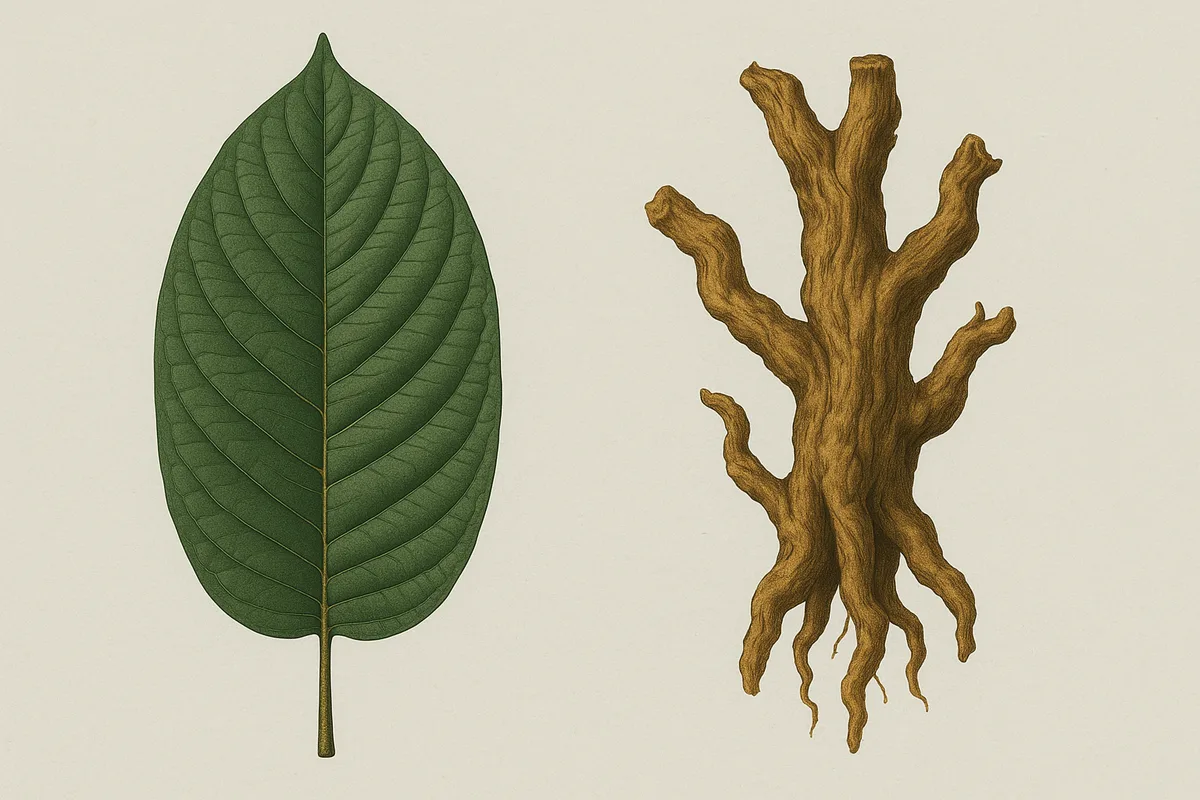
Kratom and kava get lumped together because they both show up in the same shops and both come from plants with long traditional-use histories. But they are not the same category of thing. Kratom is the leaf of a Southeast Asian tree (Mitragyna speciosa) whose alkaloids act at the body's opioid receptors; kava is the root of a Pacific-island shrub (Piper methysticum) whose kavalactones act on the GABA system. Different plant, different part, different chemistry, different legal status.
If you only remember one line: kratom is a leaf that works on opioid receptors, kava is a root that works on GABA. Everything below is the detail behind that sentence.
Safety & legal note. Neither kratom nor kava is approved by the FDA as a treatment for any condition, and nothing here is medical advice. Kratom can be habit-forming. Kratom is banned in some US states — check your local law.
Different plants, different parts
Kratom is the dried leaf of Mitragyna speciosa, a tree in the coffee family native to Malaysia, Thailand, and Indonesia. For generations, laborers across Southeast Asia chewed the fresh leaf or brewed it into tea. We cover the plant itself in what is kratom.
Kava comes from the root of Piper methysticum, a shrub in the pepper family cultivated across the Pacific islands — Fiji, Vanuatu, Tonga, Samoa, Hawaii. There it is ground and steeped in water to make a traditional social drink served at ceremonies and gatherings. The two plants are not botanically related and grow on opposite sides of the world.
Different active compounds
This is where the real difference lives, because it explains everything downstream.
Kratom's activity is driven mainly by two alkaloids: mitragynine, the most abundant, and 7-hydroxymitragynine, present in much smaller amounts but more potent. Both interact with the body's opioid receptors — the research literature describes this interaction as pharmacologically distinct from classic opioids, but the receptor family is the same one opioids act on. That mechanism is the source of both kratom's reported effects and its dependence potential.
Kava's activity comes from a group of compounds called kavalactones — kavain, dihydrokavain, methysticin, and others. Kavalactones are generally understood to act on the GABA system, the brain's primary inhibitory (calming) signaling network, along with other targets. That is a completely different pharmacological pathway from kratom, and it is why the two are not interchangeable despite being sold side by side.
Different effects people describe
Neither plant is approved to treat anything, so what follows is how users and traditional-use accounts describe the experience — not clinical claims.
Kratom is often described as dose-dependent in a way kava is not. Users commonly report that lower amounts feel stimulating and energizing, while higher amounts feel more sedating and heavy. Traditionally, Southeast Asian laborers used the leaf during work — closer to the stimulating end.
Kava is described far more consistently as calming and social. The traditional Pacific-island use is a relaxing communal drink, and modern users tend to describe a relaxed, sociable state without the stimulant end of the range that kratom users report at low doses. A mild numbing of the mouth from the kavalactones is a commonly noted feature of the traditional drink.
Different legal status
For most US buyers this is the practical dividing line.
Kava is broadly legal across the United States at both the federal and state level, and is widely sold — kava bars operate openly in many cities. Kratom is legal federally but banned in a handful of US states and some cities and counties, with several other states passing Kratom Consumer Protection Acts that set age and labeling standards. Our state-by-state legality guide reports the current status wherever you are.
So one common reason people ask "kratom or kava" is simply availability: in a state that bans kratom, kava is the one that is lawful to buy.
Different safety considerations
Both plants carry cautions, but different ones.
Kratom's central concern is dependence and tolerance. Because its alkaloids act at opioid receptors, regular heavy use can lead to physical dependence, and vendors' own labels state the product may be habit-forming and is not recommended for long-term use. Contamination in an unregulated market — heavy metals, salmonella — is the other documented risk, which is why third-party lab testing matters so much. We cover this in depth in is kratom safe.
Kava's most-discussed caution is liver-related, historically tied to certain concentrated extracts and to poor-quality or aerial-part (leaf/stem) material rather than the traditional water-based root preparation. The standard advice is to avoid combining kava with alcohol or other substances that stress the liver. Kava does not carry the opioid-receptor dependence profile that kratom does.
Side-by-side
| Kratom | Kava | |
|---|---|---|
| Plant | Mitragyna speciosa (coffee family) | Piper methysticum (pepper family) |
| Part used | Leaf | Root |
| Origin | Southeast Asia | Pacific islands |
| Active compounds | Mitragynine, 7-hydroxymitragynine | Kavalactones |
| Acts on | Opioid receptors | GABA system |
| Effects users describe | Stimulating low-dose, sedating high-dose | Calming, social relaxation |
| US legality | Legal federally, banned in some states | Broadly legal |
| Main safety caution | Dependence potential; contamination | Liver caution (esp. extracts) |
| Traditional form | Chewed leaf / tea | Water-steeped root drink |
Where to buy
We only track and compare kratom vendors, so if kratom is the one you are after, here is where to look.
Our code getketum takes 15% off at Kraken Kratom — our #1-ranked vendor, AKA GMP qualified and third-party tested, with the most specific published lab panel of any seller we track. It's the only coupon we carry, so it's the one to use.
Also worth comparing: Kats Botanicals, which offers batch-level COA lookup, and Kona Kratom, consistently the best value of the three. All three are AKA GMP qualified. See the full ranked list at best kratom vendors.
For kava, we don't sell or rank vendors — buy from a seller that specifies noble-root material and publishes testing, and treat concentrated extracts with more caution than the traditional root drink.
The bottom line
- Different plants entirely. Kratom is a Southeast Asian tree leaf; kava is a Pacific-island shrub root. They are not botanically related.
- Different chemistry. Kratom's mitragynine alkaloids act at opioid receptors; kava's kavalactones act on the GABA system.
- Different reported effects. Kratom is described as stimulating at low doses and sedating at high; kava as consistently calming and social.
- Different legal status. Kava is broadly legal in the US; kratom is banned in some states — check your local law.
- Different cautions. Kratom's is dependence potential; kava's is liver caution, especially with extracts. Neither is FDA-approved for any use.