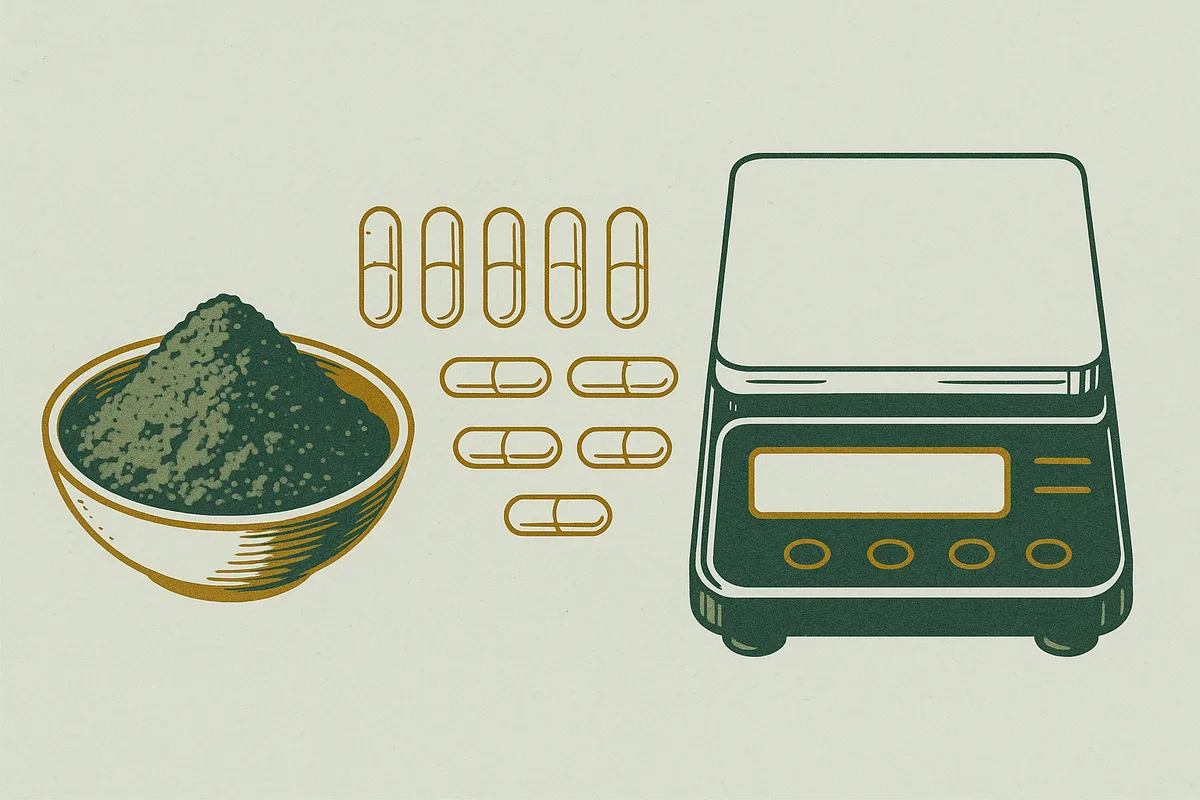
Capsules and powder are the same product — milled leaf — with one of them portioned into a shell. Nothing is added, nothing is concentrated, and nothing about the alkaloid content changes. What you are buying when you buy capsules is pre-measurement, portability, and an escape from the taste. What you pay for it is real: at the two vendors we priced this month, capsules run 65% to 140% more per gram than the identical powder.
That is the whole trade in one sentence, and for plenty of people it is worth making. The parts that trip buyers up are subtler: fill weights differ by vendor, so "four capsules" is not a portable unit, and the per-gram premium moves as much with pack size as with format. Below is what each gets you, with current prices worked out per gram.
Safety & legal note. Kratom is not approved by the FDA for any use, and nothing here is medical advice or a recommendation to take any amount. This article compares product formats and what vendors charge, not effects or outcomes. Kratom is banned in some US states and is not for anyone under 21 — check your local law.
The differences, in one table
| Powder | Capsules | |
|---|---|---|
| What it is | Milled dried leaf | The same milled leaf, encapsulated |
| Cost per gram | Baseline | Roughly 1.6–2.4× more |
| Measuring | You weigh it | Done at the factory |
| Taste | Notably bitter | None until the shell opens |
| Portability | Bag, scale, something to mix into | Bottle in a pocket |
| Onset | No shell to dissolve first | Shell must dissolve first |
| Waste / mess | Easy to spill or over-scoop | Essentially none |
A capsule count is not a unit of measurement
This is the single most useful thing to know before comparing capsule products, and it is the thing most listings bury.
Kratom capsules are almost always size 00, the standard two-piece shell. But how much leaf a vendor packs into that shell varies with grind fineness and how tightly the machine fills it — and the published figures reflect that:
| Source | Stated fill per capsule |
|---|---|
| Kraken Kratom, bulk capsule product pages | ~750 mg |
| Kraken Kratom, serving size guide (generic 00) | ~500 mg |
| Kats Botanicals, capsule product pages | 600 mg |
So four Kats capsules is 2.4 g of leaf — a figure Kats states outright on its own pages — while four Kraken capsules at the 750 mg fill is closer to 3.0 g. Same capsule size, same count, a quarter more material.
The practical consequence: a capsule count carried over from one vendor to another is not the same amount of kratom. If you are switching brands, read the stated milligrams per capsule and multiply, rather than assuming the count transfers. Our dosage guide goes further into why even a gram is not a fixed unit — alkaloid content varies by batch, so weight and strength are separate questions.
For reference in the other direction, Kraken's own serving guide puts one teaspoon of powder at 2.4 g — roughly three to four capsules, depending on whose fill you are working from.
The price gap, worked out per gram
Vendors do not publish cost per gram for capsules, and the count-based pricing makes it hard to eyeball. So we divided it out. Prices pulled from the vendors' live product pages on 15 September 2026:
| Vendor | Format | Pack | Price | Per gram |
|---|---|---|---|---|
| Kats Botanicals | Powder | 300 g | $49.99 | $0.167 |
| Kraken Kratom | Powder | 455 g | $99.99 | $0.220 |
| Kraken Kratom | Capsules | 455 g (~720 ct) | $164.99 | $0.363 |
| Kats Botanicals | Capsules | 150 g (250 ct) | $59.99 | $0.400 |
| Kats Botanicals | Capsules | 54 g (90 ct) | $25.99 | $0.481 |
Two patterns fall out of that.
First, the premium is real but not uniform. Kraken's bulk capsules cost about 65% more per gram than its bulk powder. Kats' capsules run closer to 2.4× its best powder price. If the premium is what is stopping you, the vendor you pick changes how big it is.
Second, pack size moves the number as much as format does. Kats' 90-count bottle is $0.481/g; its 250-count is $0.400/g — a 17% saving for the same capsules in a bigger bottle. That mirrors what we found across the whole market in cheapest kratom, where small bags carry roughly an 80% per-gram premium over bulk. Format and size are two separate levers, and most people only think about the first.
Worth noting: capsules are also where a discount code does the most work, because you are starting from a higher base. Fifteen percent off Kraken's bulk capsules takes $164.99 to $140.24, or about $0.308/g — which lands below Kats' capsule pricing entirely.
The shell is a spec worth reading
Capsules are made of either gelatin (animal-derived) or vegetable cellulose. Most buyers never check, and for some buyers it matters a great deal.
Kraken is the most explicit of the vendors we track: its capsules are described as all-natural vegan capsules with two ingredients — purified water and 100% natural vegetable cellulose, with no preservatives, gelatin, wheat, starch, or animal by-products, and the shells are Kosher and Halal certified. If you keep a vegetarian, vegan, kosher, or halal diet, that is a specification and not a marketing line.
Vendors that do not state a shell material are usually using gelatin. Worth asking rather than assuming.
Onset, taste, and who each format suits
Taste is the honest reason most people move to capsules. Kratom powder is bitter in a way that resists mixing, and the "toss and wash" workaround is unpleasant enough that it drives a large share of the capsule market on its own.
Onset is the trade going the other way. This is mechanical rather than mysterious: a capsule shell has to dissolve before its contents are available, which loose powder does not. Users commonly describe capsules as slower to come on for that reason. Neither is better; they behave differently, and people who use both tend to pick by situation rather than by preference.
Where the format decision usually lands:
| If you... | Where most people land |
|---|---|
| Are buying for the first time | Capsules — no scale, no measuring, no taste |
| Use it away from home | Capsules — a bottle travels, a bag and scale do not |
| Care most about cost per gram | Powder, in the largest size you will finish |
| Want to adjust amounts precisely | Powder with a 0.1 g scale |
| Want a mid-point | Powder at home, a small capsule bottle for travel |
That last row is what a lot of regular buyers actually do, and it sidesteps the premium on most of what they get through.
One format note: some vendors also sell extract softgels — Kats lists 45% extract softgel capsules — and those are a different product entirely, not leaf in a shell. Concentrates follow their own rules on strength and labelling, which we cover in kratom extract vs powder.
What the format does not change
Three things stay identical across both, and they are the three that matter most.
Testing. A capsule hides its contents, which makes the certificate of analysis more important rather than less. Heavy metals, microbials, and alkaloid identity are the same three panels regardless of format — and you cannot look at a capsule and see anything at all. Kraken publishes an average mitragynine content of 1.8% on its bulk capsule line, which is the kind of figure only per-batch testing supports.
Quality. Encapsulation is a packaging step, not a purification one — poor leaf in a shell is still poor leaf. Everything in how to tell kratom is clean applies unchanged.
Legality. Both formats are plain leaf, so both sit on the same side of the line drawn by the 2026 federal rulemaking, which targeted concentrated 7-OH products rather than leaf. State law is the variable that actually decides whether you can buy either one — see our state-by-state overview.
Where to buy
All three vendors we track are AKA GMP qualified and publish third-party lab testing, and all three sell both formats.
- Kraken Kratom — our #1 ranked vendor, AKA GMP qualified since the program launched, and the most transparent on capsule specs: stated fill weight, vegan cellulose shells, published alkaloid averages. Our code
getketumtakes 15% off — the single best lever on the capsule premium, and the only discount code we hold. - Kats Botanicals — states 600 mg per capsule on every product page and runs a batch-number lookup so you can pull the COA for the bottle in your hand. Best powder value at mid-size packs.
- Kona Kratom — third-party tested value brand selling both powder and prefilled capsules, with a money-back guarantee and the cheapest bulk powder we found.
The full ranked comparison, with testing weighted at 45%, is at best kratom vendors.
The bottom line
- Same leaf, different packaging. Capsules add no potency and remove none — you are paying for measurement, portability, and no taste.
- The premium is 65% to 140% per gram, depending on vendor and pack size. Kraken's bulk capsules carry the smallest gap of the three.
- Capsule counts do not transfer between brands. Kats fills at 600 mg; Kraken's capsule pages state around 750 mg. Read the milligrams, not the count.
- Pack size matters as much as format — Kats' 250-count is 17% cheaper per gram than its 90-count, for identical capsules.
- Check the shell. Vegetable cellulose vs gelatin is a real specification, and only some vendors state it.
- Testing matters more, not less, with capsules, because you cannot see what is in them. A current per-batch COA is the only thing that answers it.