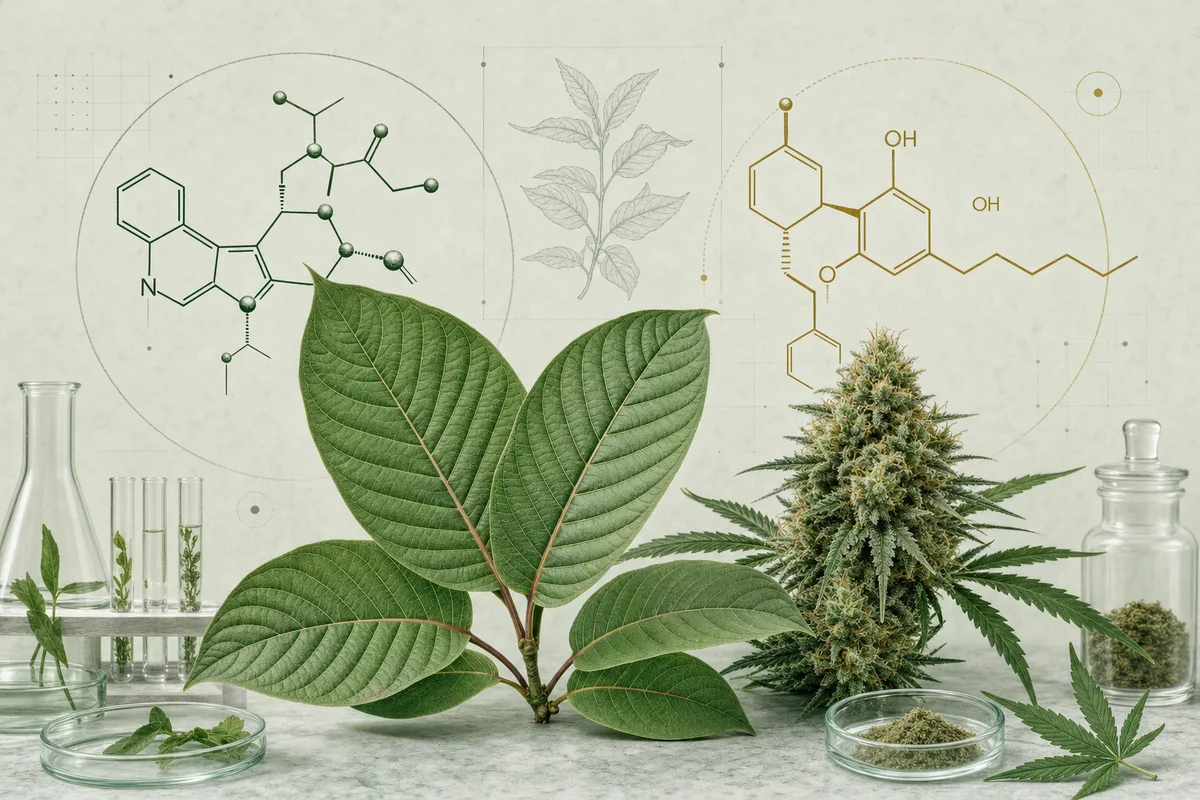
Kratom and delta-8 get shelved next to each other in smoke shops, but they have almost nothing in common chemically. Kratom is a leaf — Mitragyna speciosa, a tree in the coffee family from Southeast Asia, whose main alkaloid is mitragynine. Delta-8 is a cannabinoid — a close chemical cousin of delta-9 THC, the compound in marijuana, and almost all of the delta-8 sold in the US is manufactured by chemically converting hemp-derived CBD. Different plant, different compound class, different receptors, and — as of this month — a very different federal legal position.
The short version for anyone deciding between them: delta-8 is a THC product that will flag a standard drug test and is losing its federal hemp status in November 2026; plain kratom leaf is not a cannabinoid, is not on standard drug panels, and is not federally scheduled — though it is banned in a handful of states.
Safety & legal note. Kratom is not approved by the FDA for any use, and nothing here is medical advice. Neither is delta-8. This article reports how the two compare and what users commonly describe — self-reported associations, not established effects, and individual response varies. Kratom is banned in some US states and is not for anyone under 21 — check your local law.
Side by side
| Kratom (leaf powder) | Delta-8 THC | |
|---|---|---|
| What it is | Dried, ground leaf of a tropical tree | A THC isomer (cannabinoid) |
| Plant family | Rubiaceae (coffee family) | Cannabaceae (cannabis/hemp) |
| How it's made | Harvested, dried, milled | Mostly converted from hemp CBD in a lab |
| Main active compound | Mitragynine (plus 7-OH in trace amounts) | Delta-8-tetrahydrocannabinol |
| Primary target | Opioid and adrenergic receptors (partial activity) | Cannabinoid CB1 receptors |
| Common forms | Powder, capsules, extracts | Gummies, vapes, tinctures |
| Standard drug test | Not on SAMHSA 5- or typical 10-panel | Can trigger a THC positive |
| Federal status (Nov 2026) | Not scheduled | Converted delta-8 excluded from "hemp" from Nov 12 |
The single most useful row is the one about how each is made. Kratom powder is a whole leaf with dozens of naturally occurring alkaloids. Delta-8 occurs in cannabis only in tiny amounts, so commercial delta-8 is a conversion product — which is exactly what the new federal hemp definition targets.
What users commonly describe
The two are searched together because people are often looking for the same broad outcomes — mood, relaxation, unwinding in the evening — from something sold legally over the counter. The way users describe the experience differs.
Kratom is most often described as dose- and strain-dependent in direction. Smaller amounts and white or green veins are the ones community sources associate with energy and focus; reds are the ones named for relaxation and evening use. Our strains guide explains why vein color is the variable that tracks with those reports. Users frequently describe kratom as leaving them clear-headed, which is a large part of why some compare it to coffee rather than to cannabis.
Delta-8 is described in cannabis terms: a "high" that users commonly call milder and less anxious-feeling than delta-9 THC. Reported effects run toward relaxation, altered perception, appetite, and sleepiness — and, because it acts on the same CB1 receptors as delta-9, it is intoxicating in the way kratom typically is not described as being.
So the honest summary of the comparison: kratom is usually discussed as a functional botanical, delta-8 as a lighter version of marijuana. People choosing between them are often really choosing between those two categories.
Drug testing: the clearest practical difference
This is where the comparison has an unambiguous answer.
Standard workplace drug panels screen for THC metabolites, and delta-8 produces metabolites that immunoassay screens commonly cannot tell apart from delta-9. A delta-8 user should expect a THC-positive screen in the same way a marijuana user would; "it's legal hemp" is not a defense the test recognises.
Kratom's alkaloids are not on the SAMHSA 5-panel or a typical 10-panel. They can be detected, but only by a test that is specifically ordered to look for them. We cover which tests do and don't catch it in does kratom show up on a drug test.
Why delta-8's legal status changes this month
For years, delta-8 sat in a gap in the 2018 Farm Bill: "hemp" was defined only by its delta-9 THC content, so a product could be loaded with delta-8 and still qualify. Congress closed that gap in the appropriations law signed in November 2025 (P.L. 119-37), and the new definition arrives in two stages:
| Date | What changes |
|---|---|
| November 12, 2026 | Cannabinoids that are synthesized or manufactured outside the plant — the category commentators read as covering CBD-to-delta-8 conversion — fall outside "hemp" |
| December 11, 2026 | Total-THC standard (counting delta-8, THCA and others, not just delta-9) and the remaining provisions take effect, after a September 2026 extension |
The Congressional Research Service notes it is still unclear how actively federal agencies will enforce the new definition, and state laws continue to vary. But the direction is plain: most intoxicating hemp products on shelves today were built on the delta-9-only loophole, and that loophole is closing.
Kratom is on a different track. Plain leaf is not a controlled substance; federal action in 2026 has been aimed at concentrated and semi-synthetic 7-OH products, not leaf powder — we lay out exactly what the DEA did in kratom vs 7-OH. At the state level, kratom is banned in six states and regulated by age limits or Kratom Consumer Protection Acts in many others; see our 2026 state overview.
One overlap worth noting: the convenience-store gummies, shots and tablets that sit next to delta-8 are increasingly 7-OH products marketed with kratom imagery. Those are concentrated single-alkaloid preparations, not leaf, and they are the part of the kratom market regulators are targeting.
Can you take them together?
There is no meaningful research on combining kratom and delta-8, and both act on the central nervous system. We don't recommend combining them, and anyone taking prescription medication should talk to a pharmacist or doctor before using either. If you are curious how kratom compares with a non-intoxicating hemp compound instead, see kratom vs CBD.
Quality: both markets have the same problem
Neither product has a mandatory federal purity standard. Delta-8's conversion process can leave reaction byproducts and residual solvents if done poorly; kratom, as an imported botanical, has a documented history of heavy-metal and microbial contamination. The defence is the same for both: buy only from sellers who publish current, batch-specific third-party lab results, and read them. Our guide to reading a kratom COA walks through what to check.
Where to buy
If you've decided kratom leaf is the one you want, the vendor matters more than the strain name.
Our code getketum takes 15% off at Kraken Kratom — our #1-ranked vendor, AKA GMP qualified and third-party tested, with the most specific published lab panel of any seller we track. It's the only coupon we carry, so it's the one to use.
Two other tested vendors we track:
- Kats Botanicals — per-batch third-party testing and a broad powder and capsule menu.
- Kona Kratom — third-party tested value brand with a money-back guarantee.
For the full ranked comparison, see best kratom vendors.
The bottom line
- Different categories entirely. Kratom is a coffee-family leaf; delta-8 is a THC cannabinoid, mostly made by converting hemp CBD.
- Users describe them differently — kratom as strain-dependent and clear-headed, delta-8 as a milder marijuana-style high.
- Delta-8 can fail a standard drug test; kratom is not on standard 5- or 10-panel screens.
- Delta-8's federal hemp status ends in stages — November 12 and December 11, 2026. Plain kratom leaf remains federally unscheduled, though banned in some states.
- Don't combine them, and whichever you consider, buy only lab-tested product from a vendor that publishes its COAs.